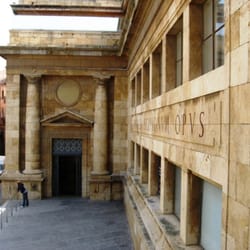
The Catalonia Archaeology Museum houses a selection of artefacts illustrating the history and…read moredevelopment of Catalonia from the early Palaeolithic period until the Visigothic period around the 6th and 7th centuries. Although it doesn't compare with the collections of museums such as the Louvre or British Museum, its collection is worth a visit for those interested in learning more about the region's early history.
As with many such collections, the artefacts from the early periods are limited to stone tools, pottery and remains from early human burials, and are best appreciated by those with a hankering for such things not helped in this case by the rather patchy and somewhat old-fashioned presentation (many of the stone-age items are particularly poorly labelled).
Things improve rapidly, however, with the presentations about the late Bronze Age, and the development of the unique cultures of Menorca and Ibiza, where the range of items from the latter's Punic (Carthaginian) civilisation is extensive. Things improve further still with the galleries presenting the Greek and Roman colonies of Empuriés (near Girona), from which some superb vases, bronzes, jewellery and votive objects have been preserved.
Best of all, however, are the remains from the Roman period, which include a very wide range of everyday objects, the quality of which compares with the sister museum of Roman life in Tarragona. Most impressive are the sarcophagi and funeral monuments, which are both well preserved and can be inspected at close quarters.
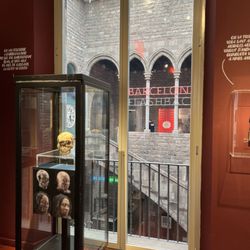
Other memorable Roman-period items especially popular with school parties, for obvious reasons - include the head of a human ritually sacrificed by having a huge nail driven into their skull, and an astonishingly virile bronze figurine of Priapus; this version doesn't even have a body as such - it's simply a huge phallus, with horses' legs at the rear, ridden (like a horse) by a woman, complete with phallic tail and equipped with two little bells. Although discovered in 1848, it was considered too risqué to put on view until 1984.
Later Roman Period finds include the remains of a magnificent circus mosaic, followed by jewellery from the post-Roman Visigothic period (5th-8th centuries).
Bags can be left at reception for free, and the staff seemed helpful and interested in us, on my visit. Most of the museum has level access with ramps or lifts, although there is no proper disabled toilet, and some of the displays may be frustratingly high for wheelchair users.
The museum has a small but rather unimaginatively presented shop area, with books, souvenirs and T-shirts for sale, and a particularly sad and dusty postcard selection. It's a pity, as a little imagination and investment could make this aspect so much better.
The Museum is on the edge of the Montjuïc Park, next to the Theatre, a fairly level 15 minute walk from Espanya Metro or a more uphill 10 minute walk from Poble Sec metro.