Cancel

    Open app

    Search

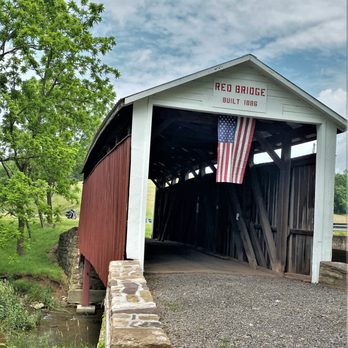
    Red Covered Bridge Photos

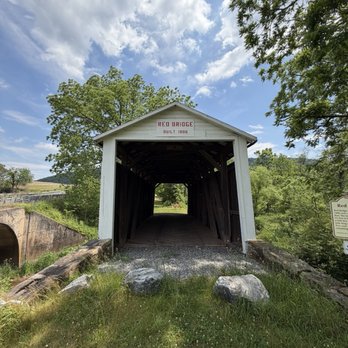
    Recommended Reviews - Red Covered Bridge

    Your trust is our priority, so businesses can't pay to alter or remove their reviews. Learn more about reviews.
    Yelp app icon
    Browse more easily on the app
    Review Feed Illustration

    2 months ago

    Helpful 8
    Thanks 2
    Love this 10
    Oh no 0

    6 years ago

    Helpful 1
    Thanks 0
    Love this 1
    Oh no 0

    Verify this business for free

    Get access to customer & competitor insights.

    Verify this business

    Joseph Priestley House

    Joseph Priestley House

    4.7(6 reviews)
    24.9 mi

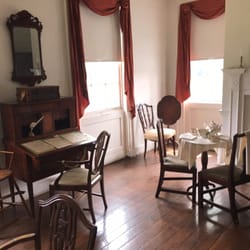
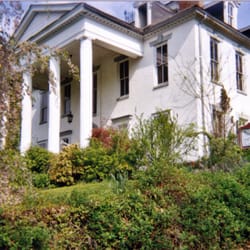
    Joseph Priestley (1733-1804) was known for identifying carbon monoxide, but mainly as the…read morediscoverer of oxygen in 1774. He was also a theologian, educator, political activist and writer. He spent the last years of his life in then rural Northumberland, Pennsylvania. He was a strong supported of the political ideas of the french revolution and had supported many religious Dissenters (both no-no's in his homeland of England), for this his house, library & laboratory were burned down, he was accused of treason and then he immigrated to The United States. First settling in Philadelphia, then moving to northumberland, he had hoped that moving to such a rural and secluded area would perhaps give him some breathing-space and time to think. He wasn't welcome as a preacher in Northumberland, but founded the first congregation of Unitarian faith in Philadelphia. His house was equipped with a laboratory, where he conducted experiments. His ideas greatly influenced Thomas Jefferson and the Constitution, and also his education planning is the basis for the liberal arts college. This is basically a tour of his original house, it has been modified since then. takes about a half-hour. 4.00 admission per person.

    Dan pretty much hits the nail on the head in his review. I'd heard of the Joseph Priestley House…read morebefore, but I'd never visited it. Not only did Priestley discover oxygen, he also conducted early experiments in electricity and counted Benjamin Franklin, Thomas Jefferson, and James Watt among his friends. His teachings were so controversial that his house in Birmingham England was burned to the ground. He and his family fled Engand and Priestley spent the last decade of his life in Northumberland. The Joseph Priestley House is a National Historic Landmark and from the outside, it looks like a typically unassuming English gentleman's estate. But it's really easy to spend some time in here. Priestley and his family not only lived here, he had his laboratory here too. And I'm happy to say that the lab has been recently renovated. When the lab was renovated, it was done so without intruding on the elements of the house. The exhibit is set as though Priestley is at work investigating carbon monoxide in his Northumberland laboratory. Reproduction glassware pieces were selected, based on pieces that Joseph Priestley was known to have used here. The original laboratory glassware is now at the Smithsonian Museum in Washington, DC. Other renovations include two representative furnaces with chimneys and a fume hood spanning the width of the lab. There's also a lot of family history in the house. His spouse Mary Priestley did a lot of the planning for the new house. She passed away, however, two years after they arrived in Northumberland and she never saw the completion of the house. As a widower, Joseph Priestley lived here with his eldest son, Joesph Priestley Jr and his daughter-in-law and his grandchildren. In 1919 Dr. George Gilbert Pond bought the house at auction. Dr. Pond was dean of the School of Natural Sciences at Pennsylvania State College (now Penn State). After his death in 1926, the college purchased the house and built the Pond House in his honor. It was used as a firepoof museum for Joseph Priestley's artificats. It once served as a visitor center, however plans are afoot to adapt it for public meetings and exhibits. I think that visiting small historical houses such as Priestley's can be just as rewarding as visiting well-known museums. If you visit the Priestley House, do the "Priestley Pilgrimage" by also visitng the Joseph Priestley Memorial Chapel, Riverview Cemetery and Northumberland's Historic District.

    Photos
    Joseph Priestley House - Joseph Priestley

    Joseph Priestley

    Joseph Priestley House
    Joseph Priestley House - The Home of Joseph Priestley:Northumberland , PA

    See all

    The Home of Joseph Priestley:Northumberland , PA

    1719 Museum  - The Lancaster Longhouse at the 1719 Museum

    1719 Museum

    4.8(8 reviews)
    57.3 mi

    Why is the Hans Herr House significant and who the hell was Hans Herr?…read more The house itself is significant as it is the last remaining structure that is still standing from the original group of Mennonites who came to the Lancaster County area to escape religious persecution from their native Switzerland. The house is also significant in that it is the oldest structure in Lancaster County and likely the oldest remaining Mennonite meetinghouse in the Western Hemisphere. The original group traveled from Switzerland to Germany to escape religious persecution then after a governmental regime change they were forced from Germany to England where they met with William Penn who allowed them to colonize a portion of what is current day Lancaster County or when they arrived in 1711, the extreme most western frontier of Pennsylvania. One interesting piece of information is that the house did not belong to Hans Herr as it was built by his son Christian which is why his initials are over the doorway along with the inscribing mark of 1719. On the tour you are told why the name remained(s) Hans Herr House versus Christian Herr House but honestly I forget why. Maybe something just deferential from Christian towards his father or because of his father's status with the original group that came to the area or maybe everyone just liked the flow of the name more so it's based on tradition? The tour itself is around 40-45 minutes and it starts in the building which houses the gift shop and you are given a brief overview of the Anabaptist faith, the Mennonites who are direct descendants of the faith and a map which shows the route the initial settlers took from Switzerland to Pennsylvania. After that you are taken over to the house where you see the three rooms which make up the first floor (kitchen, bedroom and all purpose dining room-meeting room-family room) and the second floor which is where the eight children slept and finally the basement which is accessed from a side entrance outside of the house. You learn that the key to the home's design is that they didn't believe in wasting any space so every inch served a purpose such as not having hallways so as soon as you walk in the front door you're right in the kitchen. One thing worth noting, if you are someone who is hardcore hung up on only visiting historical places if they have lots of original items then this place might not be for you. There is not a whole lot original to the house that you can see with the exception of a piece of the ceiling insulation on the first floor (rye straw + manure + ??), the wooden crossbeam over the kitchen fireplace and the steps which go from the second floor to the third floor attic (obviously you can't use them). Past that I think most everything else was changed out in the 19th century when the house was still used as a residence or in the early 70's when the initial renovation occurred to make things into a tourist destination. If you want more original take a look at the bibles on display in the gift shop which are original to Hans and Christian. I wouldn't call the Hans Herr House a must see, but it's interesting enough and the tour is the right length to keep everyone interested along with being located close enough to most of Lancaster County's tourist elements. If you go: The 1719 Hans Herr House is open April 1 through November 30, Monday-Saturday, 9:00 AM-4:00 PM. Forty-five minute Herr House tours are offered at 9 a.m., 11 a.m., 1 p.m. and 3 p.m. This is not the tour information for their reproduction Native American Longhouse. That tour is offered at 10 a.m., 12 noon and 2 p.m and has an entirely different focus. Prices are currently Adults: $8, Children 7-12: $4 and Children 6 and under: free with a slight discount if you choose to tour both structures. There are also several special events that happen throughout the year and that information is available on their website.

    I visited the 1719 Museum this past Saturday and really enjoyed the experience…read more The guided tour starts with a short film about the property that provides some great context for the rest of the tour. Then you leave the visitor center and walk over to the first structure of tour, which is a full-sized reproduction of a Native American longhouse. Longhouses (large multi-generational family homes made of logs, saplings, and tree bark) were once ubiquitous in Pennsylvania, including along the Susquehanna River. At the time the Hans Herr home was built, south-central Pennsylvania was home to several Indigenous tribes, including the Shenks Ferry, Conoy, Lenape, Mohawk, Nanticoke, Seneca, Shawnee, and Susquehannock peoples. The 1719 Museum collaborated with the Circle Legacy Center and members of the local indigenous community to build the longhouse reproduction in order to share the history of and honor Pennsylvania's native communities and educate visitors to the area. With your guide, you walk into the longhouse, where you sit down while the guide explains quite extensively about the Native communities in the area, the longhouse and its architecture, and the relationships between the indigenous people and the Mennonite people who made homes in the area. After the longhouse, the guide walks you over to the Hans Herr House. It was built in 1719 and is a 2-story, rectangular sandstone Germanic-style dwelling. It is the oldest dwelling in Lancaster County and the oldest Mennonite meetinghouse in America. The guide walks you through various rooms in the house and shares information about the Herr family as well as the larger Mennonite community in early Pennsylvania history. Our guide was Cindy, and she was incredible. I learned so much about the Native, Indigenous and Mennonite communities of 18th century Pennsylvania (and - in the case of the Native peoples - a much earlier history of their lives in Pennsylvania). She really educated us on a broad range of topics, while keeping the tour fun (I love fun education)! She made my tour extra special. If you're spending some time exploring Lancaster Counter, the 1719 Museum should definitely make your itinerary! In one place, you can learn a little bit about Pennsylvania's Native and Mennonite communities, and it's just a special place!

    Photos
    1719 Museum
    1719 Museum
    1719 Museum

    See all

    Rockville Bridge - Hubby and I came early and prepared to wait for our viewing of the Union Pacific Big Boy steam engine

    Rockville Bridge

    4.8(5 reviews)
    17.6 mi

    Who says nothing happens in Harrisburg? Today, Tuesday, July 7, crowds of people, myself included,…read morewaited to see a glimpse of the historic Union Pacific Big Boy Steam Engine #4014, built during World War II, as it passed through Harrisburg via the iconic Rockville Bridge. Hubby and I arrived around 1:00 pm to secure a spot to view the iconic train going over the historic Rockville Bridge. It was the first time the Union Pacific Big Boy steam engine train toured cities East of the Mississippi River. We knew the train stopped in Lebanon and chugged along at only 35 miles an hour until it arrived in Harrisburg three hours later. A wonderful piece of history and great to see so many people's interest in railroad history.

    All things said about this fantastic structure are true…read more 1. It is truly a marvel of engineering and was designed to be the bridge that would last forever. pabook.libraries.psu.edu/literary-cultural-heritage-map-pa/feature-articles/rockville-bridge-built-last-forever 2. If you are of a foamtastic persuasion, it doesn't get much better than this. Two Amtrak trains a day plus a ton of action from NS. Sure, PSR has killed off some of the volume, but during my recent trip this past Sunday, I got 3 NS movements and the eastbound Pennsylvanian within 15 minutes of each other. Not too shabby. To me, if you really want the best perspective, it's going to be on the water. If you rent from Susquehanna Outfitters, they do a run that drops you off at the boat launch at Fort Hunter which is just north of the bridge. From there you can basically hang out/float in place (unless there has been a huge recent rain, the Susquehanna doesn't have much of a current in this area) and hang out waiting for the next movement plus the only way to head south is to go under the bridge through one of the aqueduct arches. www.yelp.com/biz/susquehanna-outfitters-wormleysburg Whether you see it from the highway, Front Street, Fort Hunter or wherever, the structure is impossible to miss and it's truly one of a kind.

    Photos
    Rockville Bridge
    Rockville Bridge - Harrisburg history: the historic Rockville Bridge and the historic Heckton church.

    Harrisburg history: the historic Rockville Bridge and the historic Heckton church.

    Rockville Bridge - The iconic Union Pacific Big Boy Steam engine headed to Enola train yards

    See all

    The iconic Union Pacific Big Boy Steam engine headed to Enola train yards

    Red Covered Bridge - landmarks - Updated August 2026

    Loading...
    Loading...
    Loading...