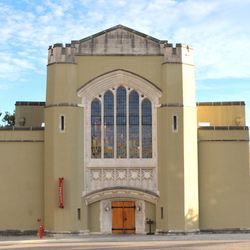
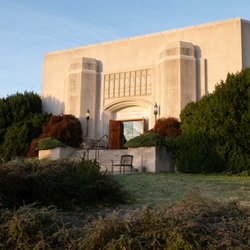
Absolutely jaw dropping experience. I am a hugeeee civil war buff and seeing this in person was…read moreamazing. You enter the chapel doors and see Lee's bodice. You are able to walk around it and take pictures. Downstairs is his crypt and office. And outside the door downstairs is all the information about Traveller!
Here's some history! It was 1861, Lee was in the mountains of West Virginia commanding a small Confederate force that would suffer defeat in the Battle of Cheat Mountain; this earned him the nickname "Granny Lee" because people thought he was afraid to shed blood. Here he met Captain Joseph M. Broun, quartermaster of the 3rd Infantry of Wise's Legion, mounted on a steed that would eventually become Lee's famous warhorse Traveller.
The original owner named the horse Jeff Davis after the Mississippi senator who would become President of the Confederacy; but when Broun bought the horse for military service he renamed him Greenbriar.
Before Lee had an opportunity to acquire the horse, he was sent on orders to the Palmetto State. Captain Broun's company was also later transferred to the Lowcountry. As fate would have it, he met Lee again at Pocotaligo.
Immediately recognizing "his colt," the general still showed such a fancy for the horse that the junior officer realized he had little choice but to offer it up as a gift. Lee declined, saying he would gladly purchase the animal. Broun let Greenbriar go for the same price at which he purchased him: $175, or approximately $4,500 in today's currency, but the General added a tip of $15 to compensate for the depreciation of Confederate money. Lee named him Traveller.
At the 2nd Battle of Bull Run, Traveller spooked and threw his master down against a stump. Lee broke both hands and finished out the campaign in an ambulance, or with a courier leading his horse. But, more generally, Traveller was noted for bravery and, at times, soldiers had to literally surround him and grab the reigns to keep him from plunging ahead with their commander onto the front lines of battle.
In his final years, Lee served as President of Washington College in Lexington, Virginia. Traveller was allowed to graze about the campus, but so many star-struck students stole hairs from his mane and tail that Lee complained in a letter to his daughter, "He is presenting the appearance of a plucked chicken."
In the fall of 1870, Lee suffered a stroke and died two weeks later. For the funeral procession, Traveller was saddled up and decked out with black crepe. He led along behind the ammunition cart bearing Lee's casket. Within a year, Traveller stepped on a rusty nail and contracted tetanus. He was shot to end his misery.
Traveller was initially buried behind the main buildings of the college, but was unearthed by persons unknown and his bones were bleached for exhibition in Rochester, New York, in 1875/1876. In 1907, Richmond journalist Joseph Bryan paid to have the bones mounted and returned to what was now Washington AND Lee University. The skeleton was periodically vandalized there by students who carved their initials in it for good luck. In 1929, the bones were moved to the museum in the basement of the University Chapel, where they stood for 30 years, deteriorating with exposure.
Finally in 1971, Traveller's remains were buried in a wooden box encased in concrete next to the chapel a few feet away from the Lee family crypt inside, where his master's body rests. The stable where he lived his last days, directly connected to the Lee House on campus, traditionally stands with its doors left open; this is said to allow his spirit to wander freely. When the 24th president of the university violated this tradition, he caught so much flack from the community that he had to have the doors repainted in a color he called "Traveller's Green," just so he could redeem himself.