At the Pendry Tea House, one does not merely have afternoon tea; one boards a doomed vessel,…read morecrosses the boundary of good sense, and descends, Virgil-less and increasingly dehydrated, into a minor but memorable circle of Dante's Inferno. More specifically, the experience recalls Canto XXVI, when Dante encounters Odysseus in Hell: the great voyager whose final journey is not wisdom, but overconfidence, misdirection, and wreckage. Pendry offered much the same voyage, except the sea was tannic tea, the ship was a sun-blasted room without air conditioning, and the wreckage cost 167 Canadian dollars.
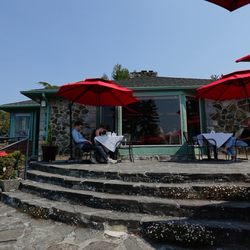
The setting was the first sign that we had passed through the gates. Rather than being seated in a calm or elegant space, everyone seemed shoved into the same glaring, sunlit room, where the lack of air conditioning turned afternoon tea into a slow roast. It was less refined Victoria tea service and more waiting room in the eighth circle: hot, crowded, and airless. If Dante had needed a modern architectural metaphor for Hell, this room would have done nicely.
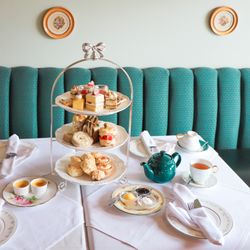
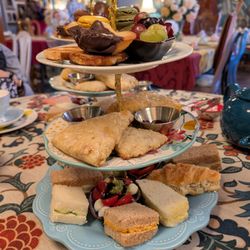
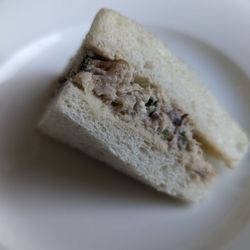
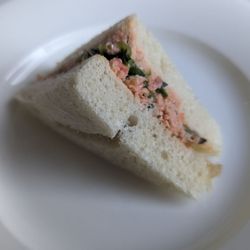
Then came the vegetarian meal, each course another island on the journey, each landing bleaker than the last. The bread was dried past redemption, as if abandoned on shore long before we arrived. The scones were burnt in a way that suggested not rustic charm, but open hostility. The cucumber sandwiches were the most haunting stop of all: barely two slices of cucumber, no discernible spread, and all the lushness of a moral allegory about scarcity. As for the vegan option, it was so dry that the Sahara might have sent a cease-and-desist for reputational damage. With each bite, another member of the culinary crew seemed to be left behind.
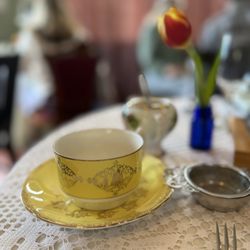
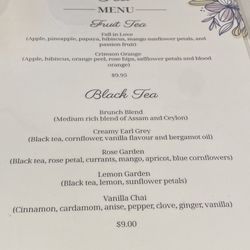
The tea itself was somehow worse, which is especially impressive at a tea house. Silk Road should strongly consider pulling any association they have with this establishment, because the staff appeared not to know the steep times for the teas on their own menu. At a tea house, steeping guidance is not ornamental; it is the rudder. Without it, the whole voyage is already lost.
The jasmine green tea tasted less like jasmine flowers and more like someone had steeped the dirt from beneath a jasmine bush. The tannic overload was so severe that I had to order a Coke simply to exorcise the taste from my mouth. It was the kind of bitterness Dante might have reserved for fraudulent counselors: those who know the language of refinement but use it to lead others into suffering.
The masala chai, meanwhile, was so weak that I do not think even someone with IBS would have found it threatening, though perhaps that is too generous, because visually it resembled the brown water left behind by data farms in AOC's mason jar. The rich golden color one expects from chai was nowhere to be found. To their credit, they did swap it for a breakfast blend, but that tea, too, arrived with no instructions, no steeping guidance, and no follow-up. No one came by to ask whether the teas were good. We had to inquire ourselves.
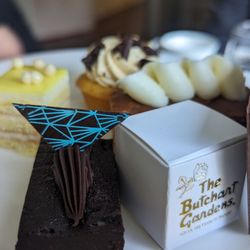
The service completed the allegory. When the trays of pastries were brought to the table, they were not presented so much as dumped upon us, as if they were refuse--which, surprisingly, they largely were. No one explained what anything was. At other tea services in Victoria, such as Butchart Gardens, there is pride in presentation. There, the staff arrived equipped with a baton and explained each item with care and ceremony. Here, our questions seemed to be treated as trespass, as if curiosity itself had violated house rules. We were not guests being guided through a service. We were passengers who had made the mistake of asking the captain where exactly he was taking us.
The finale was fittingly infernal. After removing the first of two trays, the staff disappeared for over thirty minutes and only returned with the bill after being prompted. For two people, an 18% gratuity had already been included, which perhaps explains the total absence of incentive to provide anything resembling attentive service. Like Odysseus urging his crew onward while knowing only his own ambition mattered, the house had already secured its reward. The rest of us could drift.
Hell may have no fury like that of a woman scorned, but should you wish to experience the particular fury of being packed into a hot, sunlit room without air conditioning, then served dried bread, burnt scones, cucumber sandwiches without dignity, tea brewed beyond recognition, and service conducted as though hospitality were an imposition, by all means book a table at the Pendry Tea House. At 167 Canadian dollars, it is less an afternoon tea than a guided descent: a voyage past taste, past comfort, and past the last known boundary of hospitality.