Cancel

    Open app

    Search

    W. Ross Harrell Memorial Park

    3.7 (3 reviews)

    W. Ross Harrell Memorial Park Photos

    Recommended Reviews - W. Ross Harrell Memorial Park

    Your trust is our priority, so businesses can't pay to alter or remove their reviews. Learn more about reviews.
    Yelp app icon
    Browse more easily on the app
    Review Feed Illustration

    4 years ago

    Helpful 1
    Thanks 0
    Love this 0
    Oh no 0

    3 years ago

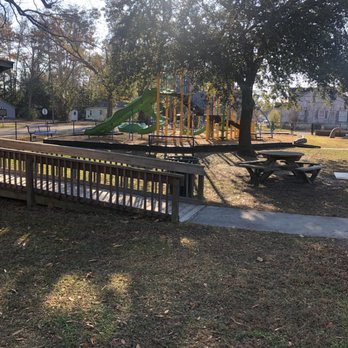
    Very cute park fenced in for my toddler to play at. Nice place to have a picnic with the family.

    Helpful 0
    Thanks 0
    Love this 0
    Oh no 0

    13 years ago

    Helpful 0
    Thanks 0
    Love this 0
    Oh no 0

    Verify this business for free

    Get access to customer & competitor insights.

    Verify this business

    Jones Lake State Park

    Jones Lake State Park

    4.2
    (17 reviews)
    39.1 mi

    Jones Lake State Park is located in Elizabethtown, NC. It is full of beauty, science and history…read more European migrants settled in the area and the lakes. Jones Lake was named for a local who donated a tract of land on which Elizabethtown was founded. Salters Lake was named after Sallie Salter. She was an American Revolutionary War heroine who famously spied on the Tories encamped along the Cape Fear River. Jones Lake State Park has a Visitor Center with restrooms and interactive educational displays. These cover the history of the area, the scientific phenomenon and the ecology. Both Jones Lake and Salters Lake are Carolina Bays with highly acidic ecosystems. They are shallow, elliptically shaped depressions found throughout the Atlantic Coastal Plain. Aerial views show that thousands of these ovals are perfectly parallel, precisely aligned along a northwest-to-southeast axis. There are many theories about these geological wonders. From wind and waves to even meteorite impacts. The industry in the area was farming and harvesting cotton and longleaf pines for the turpentine, pitch and timber. The area became overcut, and farmers could no longer survive. This led to an experiment of making these areas into parks. During the Jim Crow Era, it became a refuge for African Americans and was the state's first state park for African Americans. As most areas were segregated, the park is where the community came together culturally for baptisms, family reunions and community celebrations. In 1964, the park became desegregated. I had to double-check the date, as 1964 is not that long ago. The lake's water is tea-colored, and decomposing organic matter produces tannic acids. This lowers the pH to 4.3, so it is closer to vinegar than to lake water. It is nutrient-poor as well, so not much can survive here. The waterlogged wetland and rims create a unique evergreen shrub bog called a pocosin. The bog has evergreen bay trees such as the Sweet Bay, Loblolly Bay, and Red Bay. Bladen County is home to carnivorous plants like the Venus flytrap, pitcher plants and sundews, which thrive here. Not many fish can survive here except for acid-tolerant fish species, like the chain pickerel, yellow perch, flyer sunfish, and yellow bullhead catfish. For day visitors, Jones Lake State Park features over 50 picnic tables, charcoal grills, a sandy volleyball court, and horseshoe pits. During the warmer summer months, the park also opens a designated, roped-off swimming area with a white-sand beach.
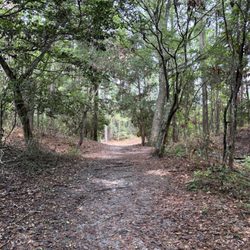
    Jones Lake State Park is a peaceful well‑kept place to camp and explore. The campground is small…read morebut usually easy to get a spot in, and the whole area is taken care of really well including the bathhouse, which is clean and maintained better than a lot of larger parks. The trail around the lake is an easy but rewarding walk. There's no elevation to worry about, just about five miles of flat, quiet trail with plenty of scenery. It's the kind of hike where you can relax and enjoy the water, the trees, and the quiet without feeling rushed. Just make sure you bring bug spray this is a large lake with standing water which is a perfect breeding ground for bugs. The park also has a fishing dock and a small boat launch that's perfect for kayaks and similar setups. One of the best things about Jones Lake is how quiet it is. You're away from crowds, away from noise, and it actually feels like you get space to breathe. Interesting fact (at least to me) Jones Lake State Park was established in 1939, and it holds an important place in North Carolina history. It was the first state park developed specifically for Black Americans during segregation its cultural significance is still a big part of its identity today. The nearby town of Elizabethtown has a quaint little downtown with a few local restaurants. There's not a ton going on, but it's a pleasant place to stop before or after your time at the park.

    Photos
    Jones Lake State Park
    Jones Lake State Park
    Jones Lake State Park

    See all

    Lake Waccamaw State Park

    Lake Waccamaw State Park

    4.5
    (12 reviews)
    36.1 mi

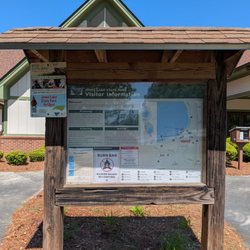
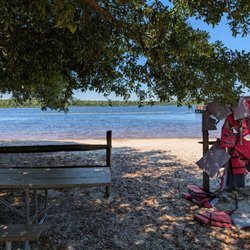
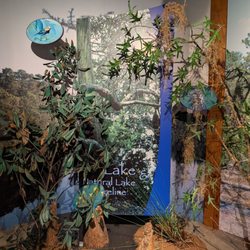
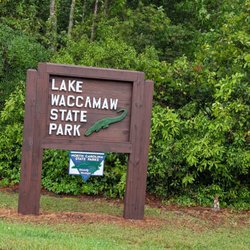
    Lake Waccamaw State Park is located in Columbus County. The Visitor Center was a great place to…read morespend a rainy day! It is filled with history and ecology. It is on the smaller side but filled with interesting information and dedicates a lot of space to the history and artifacts of the Waccamaw Siouan Indian Tribe. The Lake is the largest of the Carolina Bays. The bays are multiple oval-shaped lakes that were likely formed over the last ice age. The Waccamaw Siouan Indian Tribe viewed the lake's formation as the result of a meteor that left a deep crater. The Visitor Center explores that theory, as well as others. Lake Waccamaw was a logging town, and cypress trees were used for shingles. The weather-resistant shingles were chosen for George Washington's home in Mt. Vernon. Fifty years after the Lake Waccamaw Dam was built, the state established a state park. It started at 273 acres, but over time, more land was acquired, and the park is now 2,300 acres. The park is considered a hyper-unique ecosystem because the limestone bluff keeps the water clear, and the alkaline conditions support fish and mollusk species found only here, and nowhere else in the world, such as the Waccamaw spike mussel and the Waccamaw darter fish. They have a fossilized skull of a Balaenula whale that swam through the coastal plain millions of years ago. The Lake Waccamaw State Park is home to black bears, bobcats, carnivorous plants, and American alligators. Though the rain kept me inside this time, the park also features several trails and a scenic boardwalk that I look forward to exploring on a sunny day.

    Pulling into the visitor center for this park yielded a non-functioning water fountain. When I went…read moreinside, I didn't find much in the way of exhibitions, and when I asked about Venus Flytraps, the person there didn't know where to find them, which seems odd to me as I can't imagine I'm the first person to ask. The end of the road yielded a parking lot with no shade and a worn boardwalk to the lakefront. The lakefront is nice. The trails were a bit overgrown, and I quickly abandoned my search for rare carnivorous plants. For some users, the park will be quite nice, but I found plenty of room for improvement. Like all NC state parks, it is free.

    Photos
    Lake Waccamaw State Park
    Lake Waccamaw State Park
    Lake Waccamaw State Park

    See all

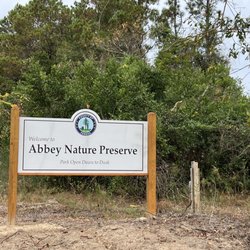
    Abbey Nature Preserve

    Abbey Nature Preserve

    4.0
    (4 reviews)
    19.4 mi

    Visited the new entrance today on Wednesday morning around 9 AM. Not many people were there, so…read morethere was still quite a few parking spots. there was one porta potty. It was a nice short hike. There was a sign at the parking lot of where the trail started, but not totally clear. You just head along the wooden rope fence on a grass dirt area until you'll get to a gate (about .1 miles), where you'll have an option of going either left or right. I decided to make a right and eventually came to another intersection where I I made a left and it was a loop trail, around .75 total miles starting from the gate. There are trail marker wooden sticks, but no trail names. No map either on site. There are garbage cans throughout the trail, dog poop bags at the start, and a couple of benches on the loop trail. It was an overcast day, so hard to tell if it was shady. If I had to guess, it would be semi shady because of all the trees. It was fairly flat, but lots of tree roots. Still manageable with my jogging stroller.

    This is a square space of Carolinian forest which is not far from the beach, but offers a different…read morevibe and plenty of tree cover. Some bridges cross over small waterways and give the opportunity to gaze over some pretty still water. Relative to the more coastal areas, the obvious advantage here is shade, and the disadvantage would be the potential for a lot of bugs in the warmer weather. There are several trails which circuit navigate the place, and it joins a historic site. It does have its own parking lot and there is no charge to get in.

    Photos
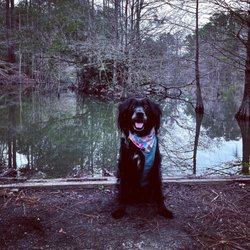
    Dog by the pond
    Dog by the pond
    Abbey Nature Preserve
    Abbey Nature Preserve

    See all

    Cliffs of the Neuse State Park

    Cliffs of the Neuse State Park

    4.4
    (44 reviews)
    47.4 mi

    Cliffs of the Neuse State Park is located in Seven Springs, NC. The park is named for the 90-foot…read morecliffs that overlook the Neuse River. I first stopped at the Visitor Center. I like visiting these as they are like a little museum in each state park. This visitor center was very interactive and had bright colors with the storyboards. I like that they covered the local ecology, the history of the river and also how we can help make better choices to keep the water safe. In the lobby, there are some taxidermies; you will see a black bear, an owl, a fox and a bobcat that lived in the area. When the fault formed, the water created the cliffs. The cliffs are unique in the layers formed. The white and yellow layers of sand and gravel are remnants of ancient beaches. The Atlantic Ocean once covered the area. Then the dark gray and black layers were made of clay likely deposited by ancient marshes. Between these layers are marine life, seashells, shale, and gravel. These got left behind as the sea levels rose and fell. These formations are 90 feet high and 200 feet underground. Native Americans gathered here, the Tuscarora and Saponi tribes. The river acted as a transportation route and a source of food. They used canoes to go from the coast to the inland forest. The high ground served as a lookout point, allowing them to see anyone approaching. They hunted deer and turkey. The museum has stone tools and other artifacts that were found in the area. During the Civil War, in the Battle of Whitehall (now Seven Springs), the Union soldiers used the higher ground to fight the Confederates. The Confederates were building an ironclad ship (the CSS Neuse). They thought being upriver would keep them safe from the Union ships. They had hoped to retake New Bern with it. The ship survived the battle with only minor damage and was moved to Kinston to have an engine and heavy iron armor added. (The ship can be seen at the CSS Interpretive Museum in Kinston, NC) I liked the phones available for a glimpse into the past from people who were part of the park, and the viewer glasses. The building is air-conditioned, and restrooms are available. There is a small gift shop too. The staff were friendly as they were expecting campers. There is an Overlook for a beautiful view. It is just steps away from the parking lot. The view was stunning. The signs make it easy to find from the visitor center. There are some trails to follow as well if you want to explore more.

    Love this park!! In the summer you're able to swim and kayak. Trails aren't that hard and scenery…read moreis nice.

    Photos
    Cliffs of the Neuse State Park
    Cliffs of the Neuse State Park
    Cliffs of the Neuse State Park

    See all

    W. Ross Harrell Memorial Park - parks - Updated July 2026

    Loading...
    Loading...
    Loading...