Okeanos Turd Statue Photos


More like Okeanos Turd Statue
Recommended Reviews - Okeanos Turd Statue
Start your review...



5 months ago
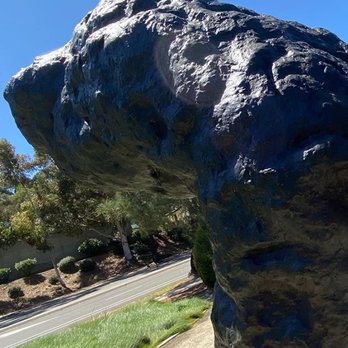
I love hidden San Diego and honestly anything that's a little odd, so once I heard about this, I had to find it and see for myself. It feels a little disrespectful to say that a sculpture looks like a turd when that wasn't the artist's intent, but... it looks like a turd. It's hard to look at it and think of anything else. At least that's what I thought. When I sent a photo to some friends and family, they were all able to quiet the intrusive thoughts of poop for long enough to think of some other possible interpretations, including: * a Cheeto or cheese puff * a giant cashew * a snake emerging from the ground * a dinosaur-sized macaroni * a rock (less creative but classier, I guess) Now, I'll just have to come back and see it again for Halloween -- I've heard that someone (who would do this?) puts giant googly eyes on it. Keep San Diego weird!! read more

6 years ago
A piece of art that really moves you, get it? Public art is always subject to debate, and in San Diego the preference tends to run on the "less-than classy side". Statues of dolphins, horses, and fishermen will barely cause a ripple on anyone's radar. However, there is one sculpture in particular that causes looks of befuddlement more than any where else. Representing a large bowel movement, this sculpture is often referred to as the "Scripps Turd" which remains its reputation to this day. The Abstract Sculpture, titled Okeanos, a.k.a. "The Scripps Turd" is made of bronze and was created by artist William Tucker. Tucker is a modern British sculpture and art scholar born in Cairo, Egypt. He attended the University of Oxford and went on to further study sculpture at Saint Martin's School of Art in London under teacher and mentor Anthony Caro. He has since received several awards and honors for his work, such as: The Guggenheim Fellowship for Creative Arts in 1986. The International Sculpture Center's Lifetime Achievement in Contemporary Sculpture in 2010. The title of National Academician at the National Academy Museum in 2011. People driving along North Torrey Pines Road in La Jolla had undoubtedly once noticed Tucker's big, hulking 13-foot piece of art in front of the Scripps Green Hospital. Despite the public's distaste for the art piece, the 3,500-pound sculpture was commissioned for $200,000 in 1987. The money came from donors in honor of Frank J. Dixon, the Director of the Institute for 25 years. Tucker named the artwork after the Greek god of rivers and oceans, Okeanos or (Ōkeanós), also known as Oceanus. Okeanos was a Titan who represented the ocean and was the eldest son of Uranus (ha) and Gaia. Tucker said the form, to him, suggested an ocean wave, and it was hailed by many critics when it was revealed. Michael Brenson, the former art critic of The New York Times, wrote of Okeanos in 1988: "The sculpture is a rippling curve that seems to spew out of the earth and curl up like a wave. It suggests not only water but also clouds and vegetation and human limbs." Alas, the public didn't feel the same way. Nor did philanthropist Edythe H. Scripps, who had "The Turd" moved to a new location by The Scripps Research Institute at the mere cost of another $40,000 (more money down the drain. I drew inspiration in recalling a smaller sculpture featured in the classic documentary film on the life of legend Joseph Dirtè (see tip photo). Upon seeing this work of art, the latter was most likely inspired by this same piece. A "chip off the old creative block" perhaps. read more


2 years ago